3-Tier Classroom Mealworm Farm
See every stage of complete metamorphosis at the same time.
Most mealworm farms are one container. Larvae, pupae, and beetles all mix together, and students can't tell which stage they're looking at.
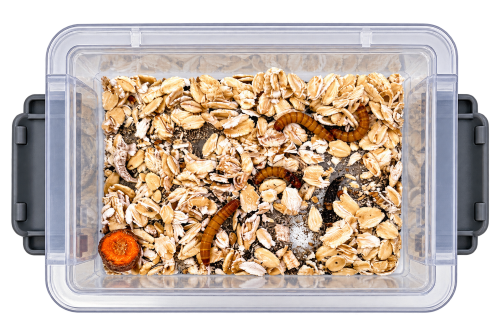
This one has three separate tiers. Put larvae in one, pupae in the next, beetles in the third. Students observe all four stages of complete metamorphosis side by side, every day, without digging through bedding to find them.
Clear on every side. Ventilated lids that lock. Stacks to under 8 inches on a windowsill or supply shelf.
What students actually see
The darkling beetle (Tenebrio molitor) is one of the cleanest models of complete metamorphosis available to a classroom. Four distinct stages. No mess, no odor, no special equipment.
Timelines vary with classroom temperature. Warmer rooms speed development; a cool room slows it down. That variable is a lesson of its own.
Because the pupa stage is the one students can never see in an incomplete life cycle, isolating it in its own tier turns an abstract vocabulary word into something on a desk.
Teaching complete vs. incomplete metamorphosis
The habitat is the live model for complete metamorphosis — egg, larva, pupa, adult. The insect's body reorganizes completely inside the pupa.
The included lesson plan and worksheet cover both types. Students raise the complete life cycle on their desk, then compare it against incomplete metamorphosis, where insects like grasshoppers and crickets skip the pupa stage entirely and hatch as nymphs that resemble small adults.
That pairing is what makes the concept stick. The pupa is the dividing line between the two life cycles, and students who have watched a mealworm curl into a pupa and emerge as a beetle understand instantly why a grasshopper nymph is different.
Live model for one. Guided comparison for both.
Standards alignment
-
NGSS 3-LS1-1 — Develop models to describe that organisms have unique and diverse life cycles but all have in common birth, growth, reproduction, and death.
-
NGSS 3-LS3-1 / 3-LS3-2 — Inherited traits and environmental influence on traits.
-
NGSS K-LS1-1 — What animals need to survive.
-
Florida SC.4.L.16.4 — Compare and contrast the major stages in the life cycles of Florida plants and animals, including those that undergo complete and incomplete metamorphosis.
-
Disciplinary Core Idea LS1.B — Growth and Development of Organisms.
What's included
Everything you need to start on day one.
-
3-tier stackable habitat with ventilated, locking lids
-
Live mealworms, shipped in the larva stage
-
Bedding substrate
-
Initial feed to get the colony started
-
Lesson plan covering complete and incomplete metamorphosis
-
Student worksheet for observation and comparison
FAQ
Do mealworms go through complete or incomplete metamorphosis? Mealworms go through complete metamorphosis. They pass through four stages — egg, larva, pupa, and adult darkling beetle. The pupa stage is what makes it complete. Insects with incomplete metamorphosis, like grasshoppers and crickets, have no pupa stage and hatch as nymphs that resemble small adults.
How long does the full mealworm life cycle take? About three to four months from egg to adult beetle at normal classroom temperature. Larvae take the longest at eight to ten weeks. Warmer rooms speed the cycle up; cooler rooms slow it down, which makes temperature a built-in variable for student investigations.
What do classroom mealworms eat? Rolled oats or wheat bran for bedding and food, plus a slice of carrot or potato for moisture. Replace the vegetable slice once or twice a week so it doesn't mold. That's the entire care routine — no water dish, no heat lamp.
Are mealworms safe for students to handle? Yes. Mealworms don't bite, sting, or carry disease, and darkling beetles can't fly or climb smooth walls. Students should wash their hands after handling, as with any classroom animal. Check with families about insect allergies before starting the unit.
What NGSS standard does a mealworm farm teach? Primarily NGSS 3-LS1-1, which asks students to develop models describing diverse organism life cycles. It also supports 3-LS3-1 and 3-LS3-2 on inherited traits, and Florida's SC.4.L.16.4 on comparing complete and incomplete metamorphosis.
Why does this mealworm farm have three tiers? Separating stages. In a single-container farm, larvae, pupae, and beetles mix together and students can't isolate what they're observing. Three tiers let a class keep each stage in its own compartment and compare them directly, which is exactly what a life cycle model asks students to do.
What stage do the mealworms arrive in? Larvae. Shipping at the larva stage means students see pupation within weeks instead of waiting for eggs to hatch. The adult beetles then lay eggs inside the habitat, so the class observes all four stages and the cycle closes on its own.
Does this kit teach incomplete metamorphosis too? Yes. The habitat is the live model for complete metamorphosis, and the included lesson plan and worksheet cover both types. Students compare the four-stage mealworm cycle against incomplete metamorphosis insects like grasshoppers and crickets, which skip the pupa stage and hatch as nymphs.